Mapping Overround Fluctuations Across Accumulator Structures in Multi-League Competitions
Written by Ellis Coleman · Aug 18, 2026

Mapping Overround Fluctuations Across Accumulator Structures in Multi-League Competitions
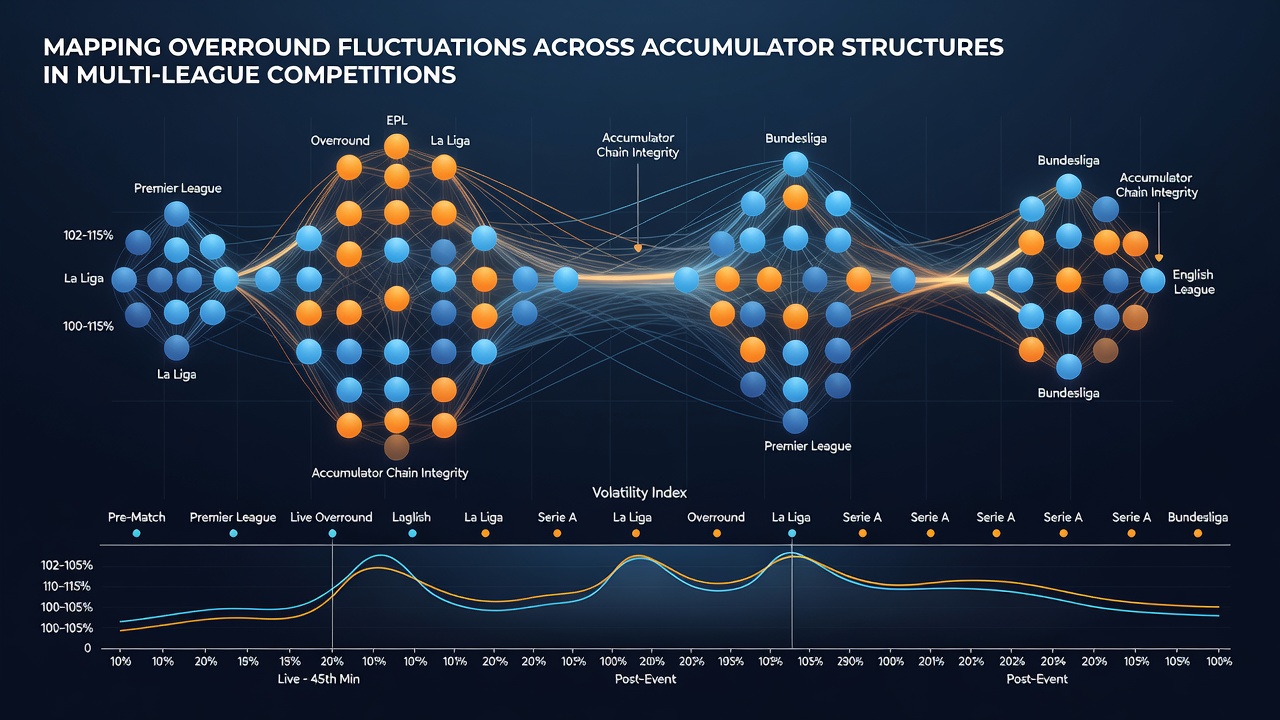
Overround represents the built-in margin that bookmakers embed in odds across accumulator bets, and analysts track its shifts when bettors combine selections from different leagues such as the English Premier League, Spanish La Liga, and German Bundesliga. Data compiled in August 2026 shows that these margins move in measurable patterns depending on how many legs appear in an accumulator and which competitions supply the matches.
Core Mechanics of Overround in Accumulators
Bookmakers calculate overround by converting decimal odds into implied probabilities and summing those percentages, then subtracting 100 percent to reveal the margin. When bettors stack three or more selections into one accumulator, the overround compounds because each leg carries its own margin, and operators adjust the combined price to maintain profitability. Researchers at academic institutions have documented that single-match overrounds typically range between 2 and 5 percent, yet the same figure climbs above 8 percent once four or five matches from separate leagues form one ticket.
Multi-league structures introduce additional variables because liquidity differs between major and secondary competitions. A Premier League fixture often carries tighter margins than a match from the Portuguese Primeira Liga, so the overall overround on a mixed accumulator reflects the weakest liquidity point in the chain. Observers note that operators widen margins on lower-profile leagues to offset the risk of sharp money concentrating on high-visibility fixtures.
Patterns Observed Across League Combinations
Analysis of historical pricing data reveals consistent differences when accumulators draw from two leagues versus three or more. Two-league tickets that pair Premier League and Serie A matches maintain average overrounds near 6.8 percent during the 2025-2026 season, whereas three-league structures that add the Dutch Eredivisie push the figure to 9.4 percent. These increases occur because operators apply wider buffers to compensate for limited market depth in the additional competition.
August 2026 pricing snapshots further indicate that pre-season friendlies and early domestic cup rounds produce sharper overround spikes than regular league play. When bettors include one such fixture in an accumulator spanning multiple countries, teh margin expansion can exceed 2 percentage points compared with all-league selections. Industry reports from the American Gaming Association highlight similar margin behavior in North American sportsbooks that offer cross-league football accumulators.
Impact of Leg Count and Correlation
Leg count remains the strongest predictor of overround growth, yet correlation between matches also matters. Selections from the same league tend to share external factors such as weather or referee tendencies, and bookmakers sometimes reduce the margin slightly to encourage volume. In contrast, matches from unrelated leagues introduce independent variables that operators treat as higher risk, prompting them to increase the overround. Studies from European gaming research centers confirm that five-leg accumulators mixing three leagues carry margins 1.5 to 2.5 points higher than five-leg tickets confined to one league.
Real-time odds feeds during the 2026 summer transfer window demonstrated another layer of fluctuation. As team news emerged and lineups changed, operators adjusted individual match margins, and those micro-changes propagated through accumulator prices. Bettors who monitored price movements across multiple bookmakers observed that the largest overround jumps occurred when a late injury announcement affected a match in a lower-liquidity league.
Tools and Data Sources for Tracking
Specialized software now aggregates live odds from dozens of operators and calculates running overround values for custom accumulator structures. Users input selected matches, and the tool returns both the combined price and the implied margin, allowing comparison across different league mixes. Regulatory filings from the Australian Competition and Consumer Commission provide public datasets on betting product pricing that researchers cross-reference with European odds to identify regional margin differences.
These datasets show that operators based in jurisdictions with stricter consumer-protection rules tend to publish slightly lower overrounds on multi-league accumulators than operators in less regulated markets. The gap narrows during peak European matchdays when competition for bettor volume intensifies.
Conclusion
Mapping overround fluctuations across accumulator structures requires attention to leg count, league liquidity, and timing within the season. Data gathered through August 2026 confirms that margins expand predictably as bettors add matches from additional competitions, and that real-time events can trigger further adjustments. Continued monitoring of these patterns supplies objective information for anyone examining how bookmakers manage risk across multi-league betting products.